Rooms of Saint Ignatius
Four bare rooms above one of the most extravagant churches in Rome, reached through a corridor that bends the walls out of shape — and hardly anyone knows the door is there.
Thousands of people a day walk across Piazza del Gesù. Almost all of them go into the church, look up at the ceiling, and leave. Immediately to the right of the façade there is a plain door into the Casa Professa, and up on the top floor are the rooms where Ignatius of Loyola lived for the last twelve years of his life, ran a religious order that was spreading across four continents, and died in the summer of 1556.
It is one of the strangest contrasts in the city: a church built to overwhelm, sitting directly beneath a set of small whitewashed rooms containing a desk, a pair of worn shoes and a black habit. From The Rabbit Hole it is about twenty-five minutes on foot, or a straight run on tram 8 to Piazza Venezia.
The order that changed Rome
Ignatius was a Basque soldier whose military career ended with a cannonball at Pamplona in 1521. What followed — a long convalescence, a conversion, years of study, and finally papal approval of the Society of Jesus in 1540 — produced the most consequential religious order of the modern era, and one run in large part from these rooms.
The rooms sit on the top floor of the modest residence Ignatius himself had built beside the church in the 1540s. Half a century later, when Superior General Claudio Acquaviva secured the patronage of Cardinal Odoardo Farnese to raise the far grander Casa Professa on the site in 1599, a decision was taken that explains everything you see: the founder’s rooms would not be demolished. Engineers built a complicated system of vaults beneath them to carry their weight, then constructed the new palace around them and stitched them into its fabric.
The result is a sixteenth-century house embalmed inside a seventeenth-century palazzo, which is why the proportions feel wrong for the building they sit in. From here the Society was governed worldwide until its suppression in 1773, and again from its restoration in 1814. Ignatius wrote the Constitutions of the order at this desk, along with a correspondence running to thousands of letters.
What to see
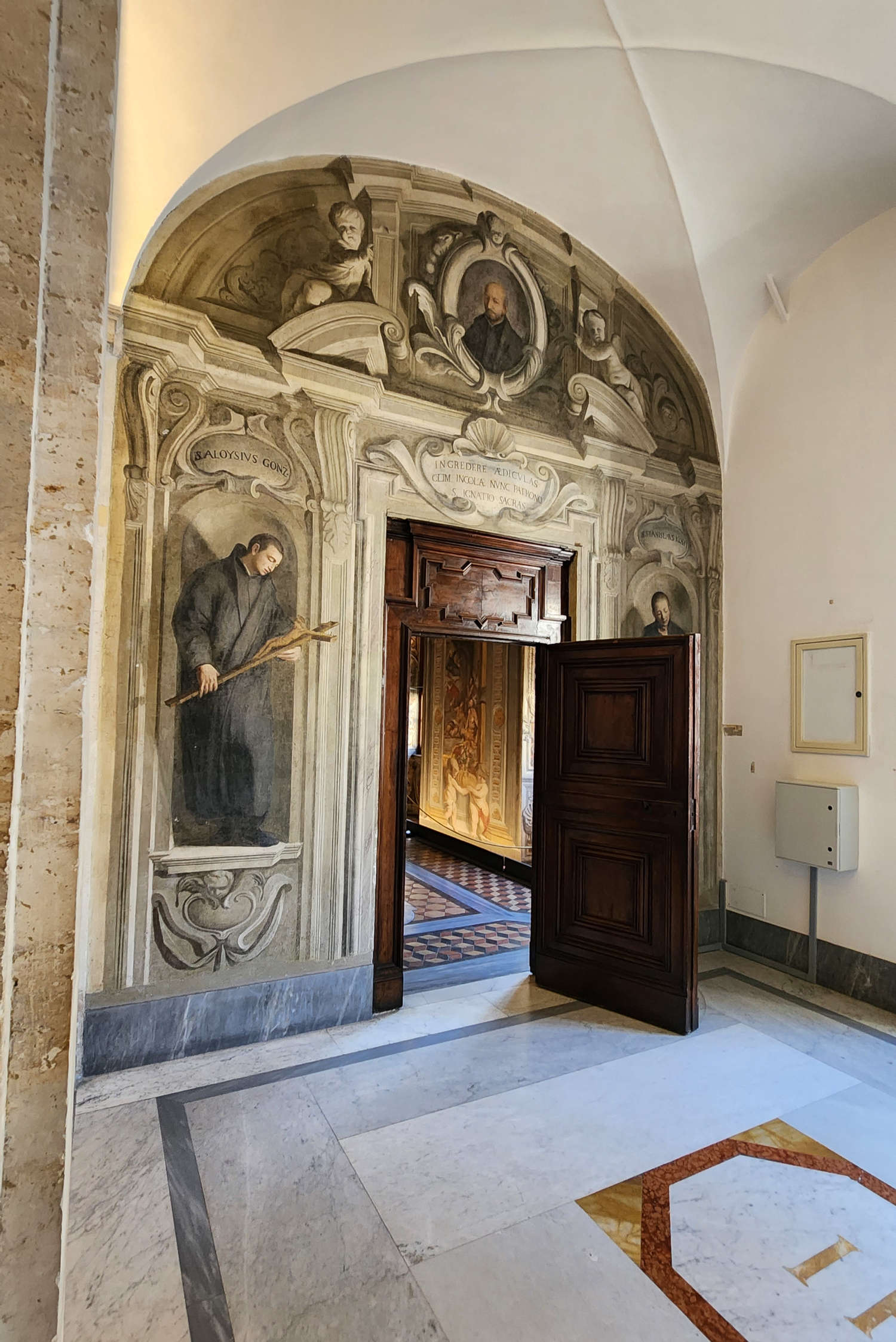
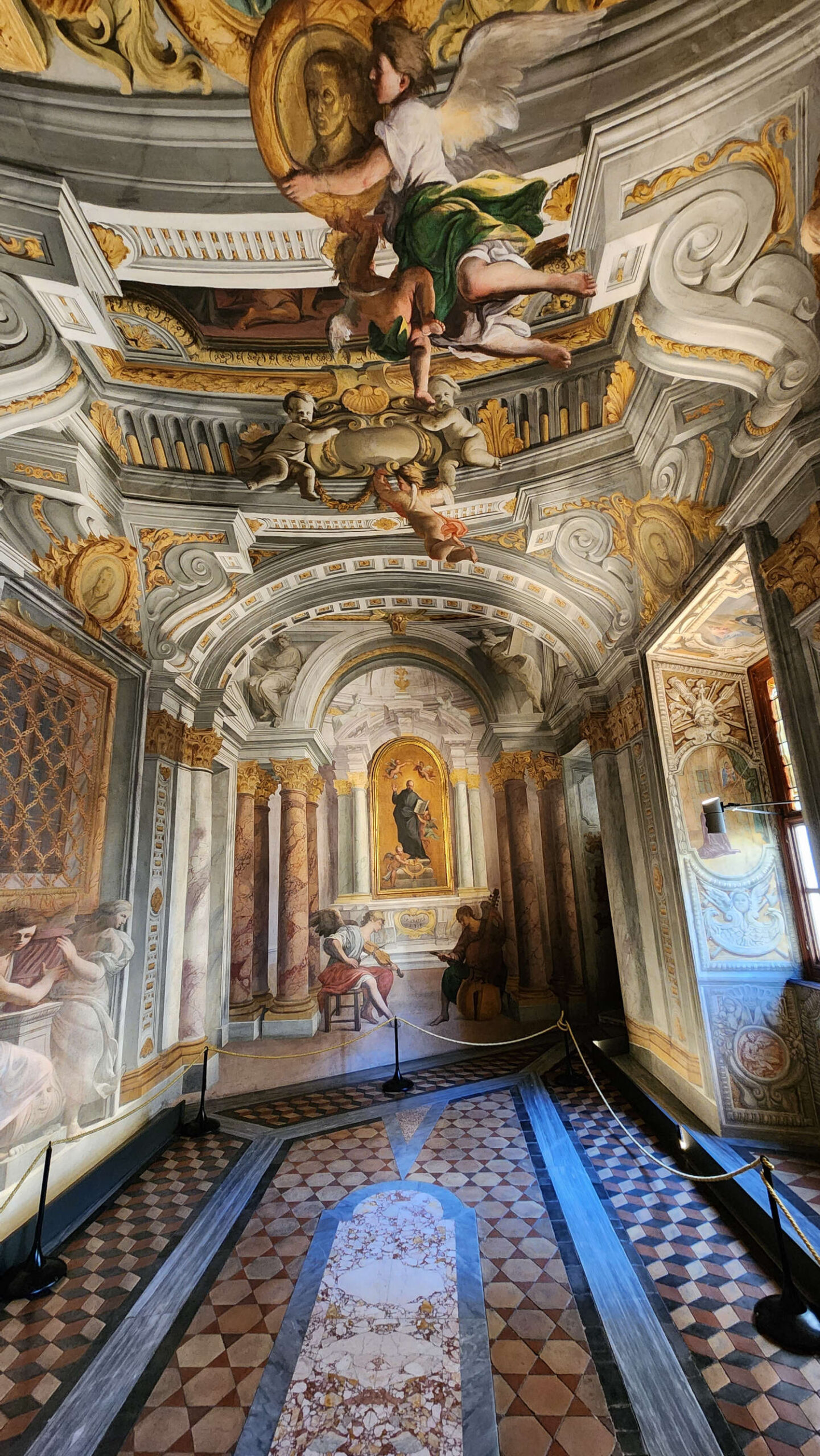
Andrea Pozzo’s corridor. The approach is the showpiece. The right-hand side was painted first, in the 1660s, by another Jesuit brother — Giacomo Cortese, the French-born battle painter known in Italy as il Borgognone. Around 1680 Andrea Pozzo, lay brother and the greatest illusionist of the Roman Baroque, took over the rest and covered every centimetre of the remaining surface with painted architecture that opens the walls into imaginary halls and vaults, framing scenes from the life and miracles of Ignatius.
The trick is calibrated to a single viewpoint, and it is marked: a marble rosette set into the floor at the centre of the corridor. Stand on it and the whole illusion snaps into place — the passage looks longer than it is, the flat figures lift into relief, the cherubs seem to face you wherever you move. Step three paces sideways and the construction collapses into distortion, which is half the pleasure.
The rooms themselves. A short sequence of small spaces kept in their original austerity — a waiting room, the room where Ignatius slept and prayed, and the largest, which served as his private chapel. Here are his desk, his wardrobe, his shoes and his habit, along with objects recovered during restoration and photographs of how the rooms looked before it.
Downstairs, the church itself. Do not skip it on the way out. The nave ceiling is Giovanni Battista Gaulli’s Triumph of the Name of Jesus, where painted figures spill past the frame and cast painted shadows on real stucco — and the point on the floor from which the perspective resolves is marked by the letters IHS, so look down before you look up. In the left transept, Pozzo’s altar of Saint Ignatius, built between 1696 and 1700, piles up lapis lazuli, alabaster, onyx, amethyst and gilt bronze over the saint’s remains, which lie in a gilded bronze urn by Alessandro Algardi.
The insider bit
Late every afternoon the Gesù performs a piece of Baroque theatre that most visitors miss entirely. To music, lights and a narrated account of the saint’s life, the enormous canvas above Ignatius’s tomb descends on a counterweight system like a curtain, revealing the silvered statue standing in the niche behind it. The whole church is illuminated for the occasion, which is also the best chance you will get to see Baciccio’s ceiling properly lit.
The macchina barocca was designed by Pozzo himself, and the statue has its own history: the original by Pierre Le Gros was melted down during the French occupation of 1798, and what you see was rebuilt in silvered stucco around the surviving fragment. It happens at a fixed hour every day — check with the church and time your visit to the rooms to finish just before.
One frequent mix-up worth avoiding: the famous painted fake dome and the vast ceiling of Saint Ignatius in Glory are in the church of Sant’Ignazio di Loyola, ten minutes away near the Pantheon — a different building, also by Pozzo. Both are worth seeing. People routinely turn up at one expecting the other.
Practical information
- Free entry, donations welcome. The Jesuit community handles visits directly.
- The door is easy to miss — it is beside the church façade, into the Casa Professa, and you may need to ring or ask a custodian to be let up.
- Opening is limited, typically an afternoon slot on weekdays and a morning one on Sundays, and it changes with the season and the community’s schedule. Always check the parish website before setting out, and never treat published hours as guaranteed.
- Dress code applies, as in any Roman church.
- Getting there from The Rabbit Hole: on foot in roughly twenty-five minutes via Ponte Garibaldi and Largo Argentina; or take tram 8 from Piazza Ippolito Nievo to Piazza Venezia and walk the last few minutes; or bus H toward Termini, getting off at Argentina.
Combine with: the rooms pair naturally with the great painters in Rome’s churches, since the Gesù is already on that trail. Largo Argentina and its sacred area are two minutes away, and the Pantheon quarter — with Sant’Ignazio and Santa Maria sopra Minerva — is a ten-minute walk north. Everything here sits inside the central day of Rome in Three Days from The Rabbit Hole.
Rome is full of places designed to impress you. This is one of the very few where the impressive part is the corridor, and the point is what waits at the end of it: a desk, a pair of shoes, and a silence you can still hear over the traffic outside.
🌿🕊️✨
#TheRabbitHoleRome #DiscoverRome #SaintIgnatius #BaroqueRome #HiddenGems