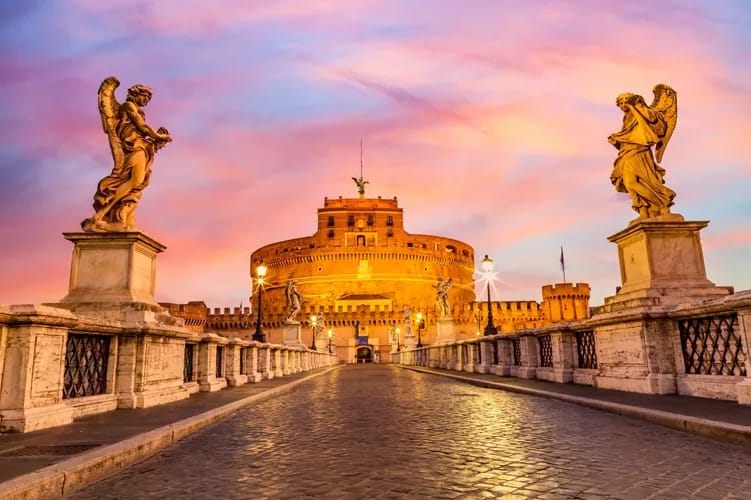
Discover Castel Sant’Angelo
Emperor’s tomb, papal fortress, opera stage — nineteen centuries in a single building.
Cross the Tiber from Trastevere on foot, walk half an hour along the river past the Vatican, and you’ll find yourself in front of one of the strangest and most storied buildings in Rome. Castel Sant’Angelo — the Castle of the Holy Angel — began life as the tomb of an emperor, became a fortress, a papal palace, a prison, and finally a museum. Every century has left its mark on the massive cylinder of travertine that dominates the right bank of the Tiber, and today you can walk through all of them in a single visit.
From Hadrian’s tomb to the fortress of the popes
In the 130s AD, the emperor Hadrian — the same builder who gave us the Pantheon and Hadrian’s Wall in Britain — began work on a mausoleum for himself and his family. He did not live to see it finished. His successor Antoninus Pius completed it in 139, and for the next century Roman emperors from Hadrian to Caracalla were buried inside its immense cylindrical drum, crowned in antiquity by a great bronze quadriga driven, in some accounts, by the emperor himself.
In the early Middle Ages, as Rome shrank and the barbarian threat grew, the tomb was fortified into a stronghold guarding the approach to the Vatican. Its modern name comes from the year 590, when a plague was ravaging the city. Pope Gregory the Great led a procession through the streets and, as he crossed the bridge, is said to have seen the Archangel Michael appear on top of the mausoleum in the act of sheathing his sword — a sign that the plague was over. Ever since, the building has been called Castel Sant’Angelo, and a bronze statue of the angel still stands watch on its terrace.
Over the centuries the popes turned the fortress into their private refuge, connecting it to the Vatican by the Passetto di Borgo and adding sumptuous apartments on the upper floors. They also used it as a prison. The philosopher Giordano Bruno was held here in the years before his execution; the goldsmith Benvenuto Cellini, imprisoned by Paul III, staged one of the most famous escapes in history by lowering himself down from a bastion on knotted bedsheets — and then wrote the whole story into his autobiography.
What to see
The Helicoidal Ramp. The original spiral corridor built by Hadrian’s architects to carry the emperor’s funeral bier up into the burial chamber. Walking it today, on the same herringbone brick paving where Roman priests once carried imperial urns, is one of the most extraordinary sensations in Rome.
The Papal Apartments. On the upper floors, the popes furnished themselves rooms fit for the most powerful court in Europe — frescoed loggias by pupils of Raphael, marble bathrooms, and the sumptuous Sala Paolina, decorated for Paul III Farnese in the 1540s with mythological and allegorical scenes.
The Treasury Room. In the heart of the ancient mausoleum, a large circular room once held the papal treasury and the secret archives of the Vatican, protected behind massive iron doors. The wooden chests where the popes stored their gold are still there.
The collections. Sculptures, paintings, marble fragments, arms and armour, furniture — much of it recovered from excavations of the helicoidal ramp itself, or donated by the Museo Nazionale Romano at the Baths of Diocletian and by the dissolved Museo Artistico Industriale. The castle also preserves an important collection of memorabilia from the Italian Army.
The terrace and the angel. The climb ends on the upper terrace at the feet of the bronze Archangel Michael cast by Peter Anton von Verschaffelt in 1753 — with what many Romans consider the single most beautiful panoramic view of their city. From here you look straight down on Bernini’s angels on Ponte Sant’Angelo below, across to St. Peter’s dome on one side, and over the entire historic centre on the other.
The insider tip: Puccini’s Tosca and the Passetto
Two stories bring this terrace alive.
The first is Puccini’s Tosca. The opera’s tragic final act unfolds on the very ramparts you are standing on — at dawn, Cavaradossi is shot against these walls by the firing squad, and Tosca throws herself from the parapet into the Tiber below with the cry “O Scarpia, avanti a Dio!”. Even if you have never seen the opera, the scene has entered the imagination of the city. Ask a Roman where Tosca died, and they will point to this terrace.
The second is the Passetto di Borgo — in Roman dialect, er Corridore — the fortified elevated corridor built along the top of the Vatican walls, connecting the Apostolic Palace directly to the fortress. It was designed as an escape route for the popes in times of danger, and it was used in earnest twice: in 1494, when Alexander VI Borgia fled here from the invading army of Charles VIII of France, and even more dramatically in 1527, when Clement VII Medici raced along it as the Landsknecht mercenaries of the Emperor Charles V began the terrible Sack of Rome below him. Legend has it that Clement grew his beard in mourning for the destruction of the city — and, some say, as a disguise to help his escape. Every pope after him wore a beard, all the way down to Paul V in the seventeenth century.
The Passetto is opened to visitors only at certain times of the year.
Practical information
- Where: Lungotevere Castello, on the right bank of the Tiber at the end of Ponte Sant’Angelo. About thirty minutes on foot from The Rabbit Hole along the river, or a short ride on bus 40 or 62 from Largo Argentina.
- Entry: Standard museum ticket; combined tickets are sometimes offered with special exhibitions.
- Opening hours: Every day except Monday, morning to early evening. Check on arrival for seasonal variations.
- Passetto di Borgo: Open only for guided visits at selected times of year — ask at the ticket desk.
- Best time to visit: Late afternoon, so you can climb to the terrace as the light turns golden and stay for the sunset over St. Peter’s.
Few places in Rome tell so much history in so small a space. You enter the tomb of a Roman emperor, walk through a medieval fortress, cross the bedrooms of Renaissance popes, and emerge on a terrace where an opera heroine once threw herself into the Tiber. Nineteen centuries, one spiral staircase. 🌿🕊️✨
#TheRabbitHoleRome #DiscoverRome #CastelSantAngelo #Tosca #HiddenGems