Ostia Antica
The best-preserved Roman city you’ve never heard of — a day trip from Trastevere.
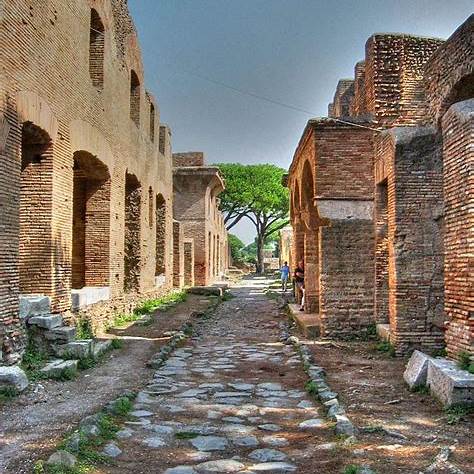
Rome has Pompeii’s fame, but Rome also has its own Pompeii, and it sits half an hour from the historic centre by suburban train. Ostia Antica, the ancient port city at the mouth of the Tiber, was for six centuries the beating commercial heart of the Roman Empire. When the river silted up and the sea retreated, the town was abandoned — and slowly buried under sand and marsh, which is why so much of it still stands today. To walk down its main street is to step into an entire Roman town, complete with its houses, shops, bars, temples and theatre.
The port that fed Rome
Ostia was traditionally founded in the 4th century BC as a military outpost — its name comes from ostium, the “mouth” of the Tiber — but its real destiny was commerce. By the 1st century AD, every ship carrying Egyptian wheat, Spanish olive oil, African wild animals or Gaulish wine to the imperial capital unloaded here. Warehouses (horrea), guild offices and multi-storey apartment blocks (insulae) sprang up around the port. At its peak the population reached around 50,000, a mixed and cosmopolitan crowd of merchants, freed slaves, sailors and immigrants from every corner of the Mediterranean.
Rome could not exist without Ostia. And when, from the 4th century onwards, the Tiber began to silt up and the coastline slowly moved further west, Ostia declined with equal speed. By the early Middle Ages it was almost empty. By the Renaissance, only the tips of the tallest buildings still emerged above the marsh. What buried the town — sand and neglect — is also what preserved it.
What to see
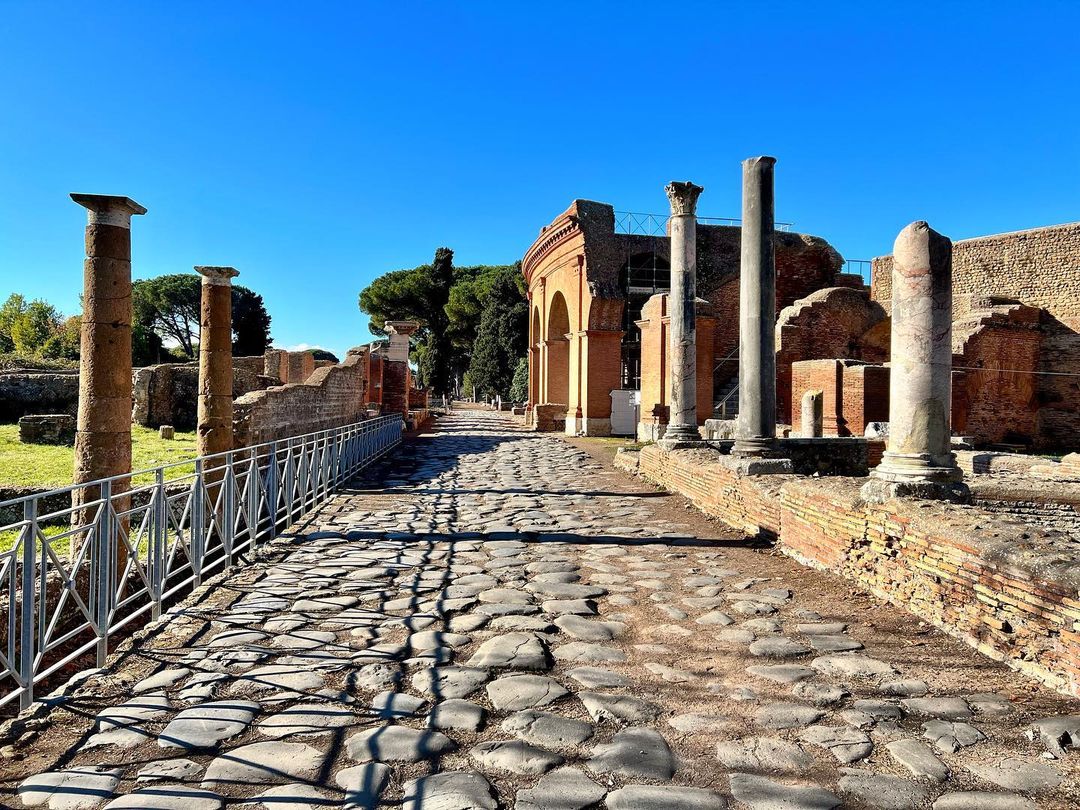
The Decumanus Maximus. The main street runs the length of the city, paved in the original basolato stones. Walking it, you pass warehouses on one side, temples on the other, the theatre in front of you — a real Roman town, laid out at real Roman scale.
The theatre. Built under Augustus by his general Agrippa, restored and enlarged by Commodus in the 2nd century, this open-air theatre still holds an audience of around three thousand. In summer, classical plays and concerts are staged here — check the local programme if you visit between June and September.
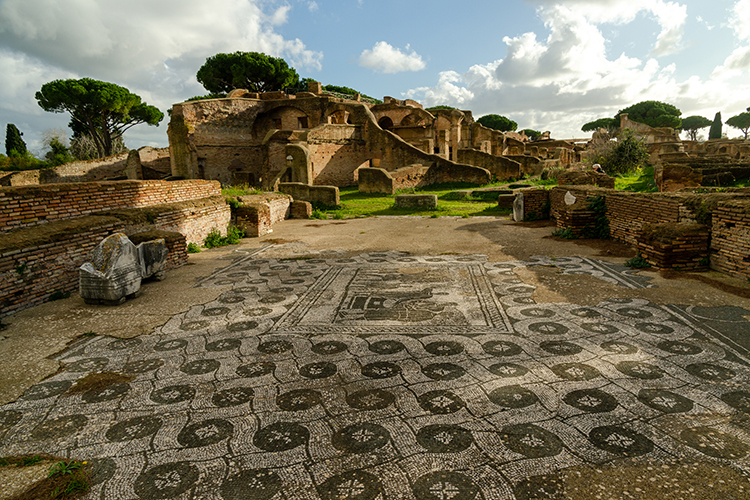
The Piazzale delle Corporazioni. Immediately behind the theatre, the “Square of the Corporations” is one of the most extraordinary things in all of Roman archaeology. A porticoed square where the shipping companies of the Mediterranean had their offices — each identified by a black-and-white mosaic on the pavement in front, showing its trade and its home port. You can still read Navicularii Karalitani (the shipowners of Cagliari), or make out a mosaic ship, an elephant, a lighthouse from Alexandria. It is the closest thing we have to an ancient Roman business district.
The Baths of Neptune. A large public bath complex whose main hall is paved with a magnificent black-and-white mosaic of the god Neptune riding across the waves in a chariot drawn by sea-horses, surrounded by tritons and dolphins.
The Thermopolium of Via di Diana. The ancient equivalent of a tavern-cum-fast-food shop, preserved almost intact: the marble counter where hot food and wine were served, the shelves for jars, and — above it all — a frescoed painting of what was on the menu: eggs, olives, radishes, fruit, a cup of wine.
The House of Diana and the House of Cupid and Psyche. Two beautifully preserved dwellings that show how ordinary Romans actually lived. The House of Diana is a rare surviving example of an insula, a multi-storey apartment block for middle-class families. The House of Cupid and Psyche is a small aristocratic domus with a marble fountain and coloured wall panels still in place.
The Serapeum. Among the many temples of Ostia, the sanctuary dedicated to the Egyptian god Serapis is one of the most fascinating and one of the least visited. Recently restored and reopened to the public, it testifies to the deep influence of Eastern religions in imperial Rome — a syncretic city of many gods, long before the triumph of Christianity. If you enjoy this thread, you will love the Crypta Balbi too, where a similar shrine to Eastern deities was excavated in the heart of Rome itself.
The Synagogue. At the far edge of the site, near the ancient shoreline, are the remains of one of the oldest synagogues in the Western world, dating from the 1st century AD. Simply reaching it — a long walk through empty ruins with wildflowers growing between the stones — is part of the experience.
Why Ostia is unlike other archaeological sites
Unlike the Colosseum or the Forum, Ostia lets you inhabit it. There are no queues, few ropes, few closed rooms. You can climb into houses, sit in a shop, cross the courtyards of temples, wander streets at your own pace. On a weekday morning in autumn or spring, you can walk for an hour without seeing another visitor. Bring water, wear a hat and comfortable shoes: the site is very large, and shade is scarce in high summer.
Practical information
- Where: Viale dei Romagnoli, Ostia Antica — a few kilometres west of Rome.
- How to get there: From Trastevere, take tram 8 to Piazza Venezia, then metro line B one stop to Piramide. Change there for the Roma-Lido suburban train (a normal Metrebus ticket, no supplement) and get off at “Ostia Antica” — about 25 minutes from Piramide. The archaeological entrance is a ten-minute walk from the station. Total journey from The Rabbit Hole, around one hour.
- Entry: Integrated ticket valid across the whole archaeological park for several days. Reductions for EU citizens 18–25.
- Free admission: First Sunday of every month.
- Opening hours: Every day except Monday, morning to late afternoon (longer hours in summer, shorter in winter). Always worth a check before you go.
- Best time to visit: Weekday morning in spring or autumn. Avoid July and August afternoons — no shade.
Rome shows you emperors and popes. Ostia shows you the shopkeepers, the sailors and the dockworkers who made the empire actually run. Half a day here, and Rome itself will start to make more sense. 🌿🕊️✨
#TheRabbitHoleRome #DiscoverRome #OstiaAntica #AncientRome #HiddenGems