
Basilica of San Clemente
Three churches stacked on top of each other, and two thousand years of Rome under a single roof.
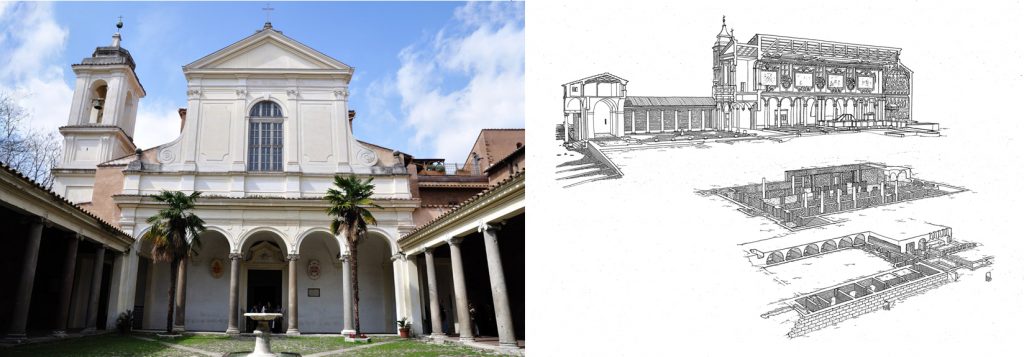
Ten minutes’ walk east of the Colosseum, on a quiet corner where few tourists ever turn off, stands a modest 12th-century basilica dedicated to Saint Clement. Step inside, and you find one of the most beautiful medieval churches in Rome — golden mosaics, a Cosmatesque floor, an early Renaissance chapel. Then buy a small ticket, walk down a staircase, and discover that this church is only the top layer of something much stranger: two earlier buildings, older and older, still standing in the ground beneath it, all the way down to a 1st-century Roman house where an underground stream can still be heard flowing towards the Tiber. There is no other place in Rome quite like it.
Rome as a layer cake
The Basilica of San Clemente is a rare surviving example of what most of Rome must once have looked like: a place where every century built directly on top of the last, without ever fully erasing what came before. Three levels are open to the public today, and to descend from one to the next is to walk backwards through a thousand years at each step.
The complex has been in the care of the Irish Dominican friars since 1667, and it is their patient excavations from the mid-19th century onwards that revealed the hidden lower levels. The dig is still going on to this day.
The upper basilica (12th century)
The church you enter from the street was built in the 1120s, after the earlier basilica below was damaged in the Norman sack of Rome and abandoned. It is one of the most beautiful medieval interiors in the city.
The apse mosaic. Above the altar glows one of the great mosaics of the Middle Ages: the Triumph of the Cross, with Christ crucified surrounded by twelve doves for the twelve apostles, and a huge vine of acanthus scrolls unfurling across the entire golden background — the vine of life, filled with birds, flowers, saints, and tiny scenes of daily life.
The marble choir screen. The white marble enclosure in front of the altar is much older than the church itself: it was salvaged from the earlier 6th-century basilica below, and carefully reassembled here when the new church was built.
The Cosmatesque floor. One of the finest medieval geometric marble floors in Rome, made from thousands of fragments of ancient coloured marble laid into intricate wheels and ribbons — most of it recycled from the ruins of imperial Rome.
The Chapel of Saint Catherine. In a small side chapel, a cycle of early 15th-century frescoes by the Florentine painter Masolino da Panicale tells the story of Saint Catherine of Alexandria — one of the earliest and finest examples of Renaissance painting in Rome, painted around 1430.
The lower basilica (4th century)
Down a stone staircase, you enter the earlier church that lay abandoned and forgotten for seven centuries. Its shape — a nave, side aisles, an apse — is partly obscured by medieval walls and 19th-century brick pillars that hold the modern church up above your head. But what has survived here is extraordinary.
The medieval frescoes. The walls of the 4th-century basilica are covered with painted layers from the 8th to the 11th centuries, forming one of the most important cycles of medieval Roman painting anywhere. Byzantine Virgins from the 8th century. A rare 9th-century Anastasis — Christ pulling Adam and Eve out of Hell. And a series of vivid 11th-century narrative scenes on the walls of the nave.
The Legend of Sisinnius. In one of the 11th-century frescoes, painted with speech scrolls above the figures like an ancient comic strip, a Roman pagan named Sisinnius orders his servants to drag Saint Clement away in chains — but the servants find themselves dragging a heavy stone column instead. Above the scene, in painted letters, they curse each other in vernacular language: “Fili de le pute, traite!” — a rough Italian shout of exasperation. It is one of the earliest known written examples of the Italian language, painted on this wall almost a thousand years ago, and one of the most quietly astonishing things to read anywhere in Rome.
The tomb of Saint Cyril. At the far end of the lower church lies the venerated tomb of Saint Cyril, who together with his brother Methodius evangelised the Slavic peoples in the 9th century and invented the alphabet that became modern Cyrillic. Named a patron saint of Europe, Cyril is honoured here by pilgrims from every Slavic nation, who often leave flags and small tributes at the shrine.
The Roman level (1st century)
One more staircase, one more thousand years, and you emerge into ancient Rome itself.
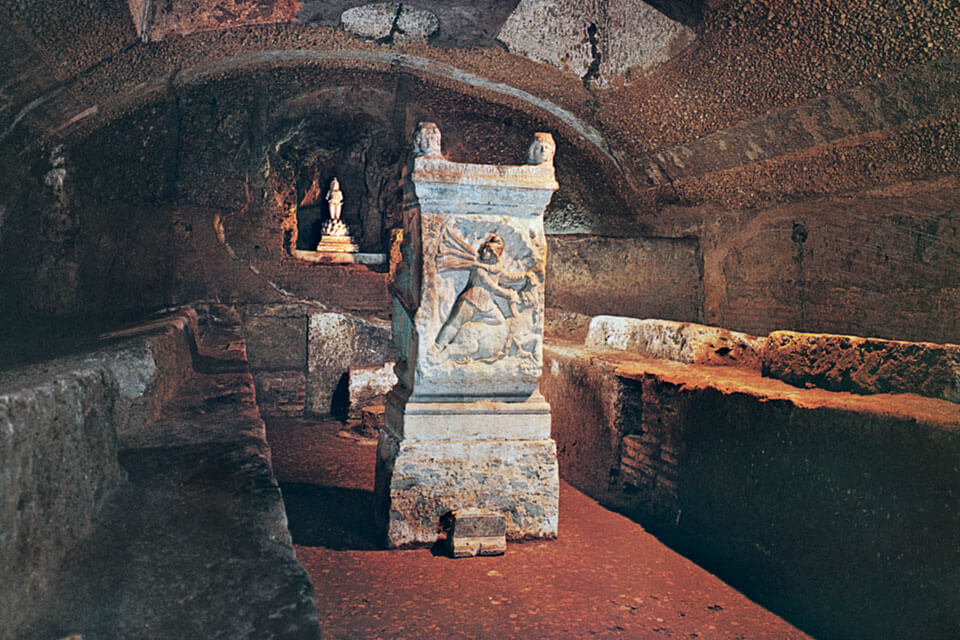
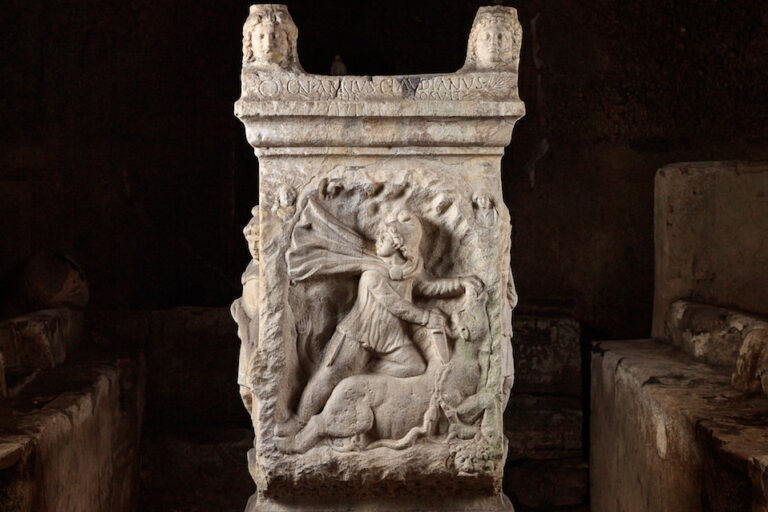
The Mithraeum. In the late 2nd century AD, followers of the Persian god Mithras installed one of their secretive cult rooms inside the cryptoporticus — the semi-subterranean gallery — of an existing 1st-century Roman house. The stone altar, carved with the god Mithras slaying the sacred bull, still stands in its original place, with benches on either side where the initiates once dined. Mithraism was for a time a serious rival to Christianity across the empire, especially among soldiers and merchants; standing in this small dark room, you can feel why.
The domus. Around the Mithraeum you can still see the original rooms of the Roman house, complete with stucco decoration and a triclinium (dining room) from the 1st century AD.
The public building. Across a narrow ancient alley — walking through it feels like slipping through a rip in time — rises a huge structure built of great blocks of tufa capped by travertine. Archaeologists now believe it was part of the imperial mint of Rome, where the coinage of the empire was struck.
The water. Throughout this deepest level, you can hear water flowing beneath the floors — an ancient underground stream that has never stopped, carrying the lost waters of imperial Rome towards the Tiber. Stand still for a moment and just listen.
Practical information
- Where: Via Labicana 95, a ten-minute walk east of the Colosseum. About forty minutes on foot from The Rabbit Hole, or take tram 8 to Piazza Venezia and then walk up through the Fori Imperiali.
- Upper basilica: Free entry.
- Lower levels (4th-century basilica, Mithraeum, Roman house): Small ticket at the entrance to the excavations. Bookable online in advance — recommended on weekends.
- Opening hours: Every day, morning and afternoon (short closure around lunch, shorter hours on Sundays and holidays). Always worth a check on arrival.
- Combine with: the Crypta Balbi, for another extraordinary journey through Rome’s stratified past — the two together form the finest short course in the layered history of the city.
Most visitors to Rome stand on the surface. San Clemente is the place to go under it. Bring an unhurried afternoon, a good pair of shoes, and a willingness to hear the past whispering through running water. 🌿🕊️✨
#TheRabbitHoleRome #DiscoverRome #SanClemente #AncientRome #HiddenGems

Discover more about its amazing history.