Santa Maria in Trastevere
The oldest basilica in Rome dedicated to the Virgin, five minutes from your door.
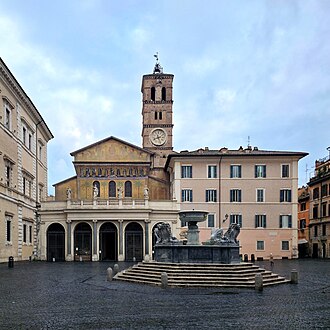
Cross Piazza San Cosimato, walk past the fountain in Piazza di Santa Maria in Trastevere, and you’ll stand in front of one of the most beloved churches in the city. Santa Maria in Trastevere is not exactly a hidden gem — the piazza in front of it is one of the most photographed corners of Rome — but very few visitors know that behind its warm mosaic façade lies more than seventeen centuries of history, and one of the great masterpieces of medieval Italian painting.
The oldest Marian church in the West
Tradition holds that the first Christian house of prayer on this site was founded in the 3rd century by Pope Callixtus I, making it — according to many scholars — the earliest church in Rome dedicated to the Virgin Mary. A local legend, older still, tells of a spring of oil that gushed from the ground here in 38 BC. Early Christians read it as a sign announcing the coming of Christ, and the Fons Olei is marked in the church to this day.
The basilica you see now was rebuilt in the 1140s by Pope Innocent II, who was born in Trastevere and wanted to leave his neighbourhood a monument worthy of his family. Nearly nine centuries later, it is still the beating heart of the quarter.
What to see
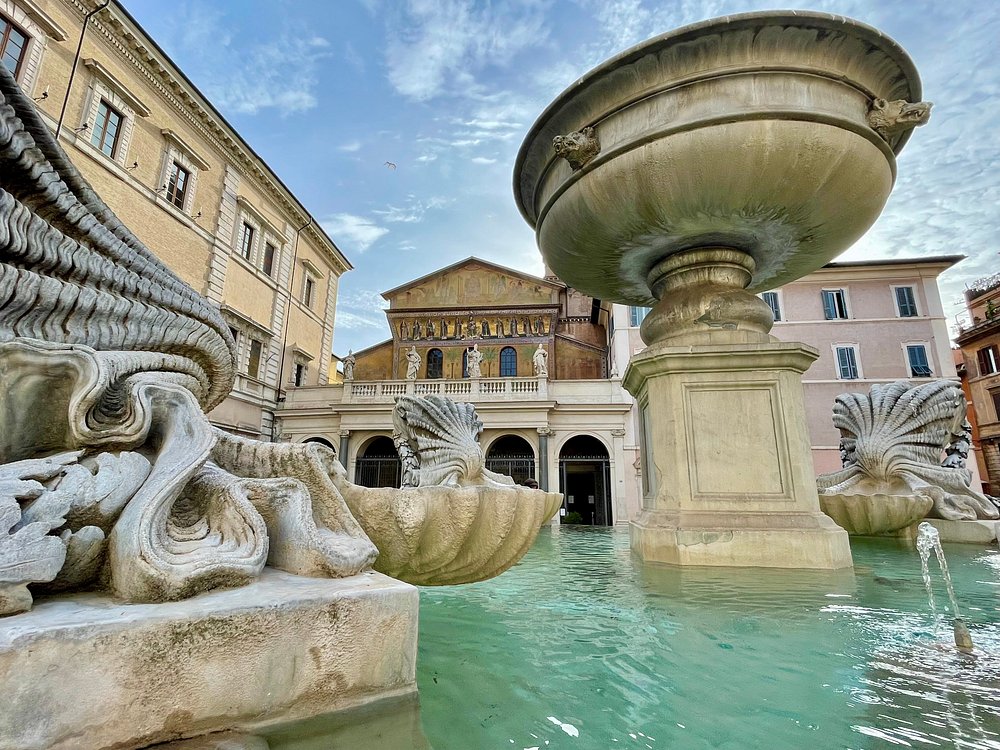
The 12th-century façade mosaic. Before you even step inside, look up. The Virgin sits enthroned nursing the Christ Child, flanked by ten women bearing lamps — an image drawn from the parable of the wise and foolish virgins. The gold glows deepest at sunset.
The ancient columns. Inside, twenty-two Roman columns line the nave. They are spolia, salvaged from imperial monuments — most likely the Baths of Caracalla — and if you look closely at the capitals you can still see the faces of pagan gods watching over a Christian church.
Domenichino’s coffered ceiling. The gilded wooden ceiling, designed in 1617, is centred on a canvas of the Assumption of the Virgin by Domenichino — a rare survival of a Baroque painting in its original architectural setting.
The apse mosaic. Above the altar, one of the greatest 12th-century mosaics in Italy: Christ and the Virgin enthroned side by side as king and queen of heaven, an iconography almost unique in Rome. Innocent II himself is portrayed on the left, holding a model of the church he rebuilt.
Cavallini’s Stories of the Virgin. Just below the apse mosaic, in a band running around the curve of the wall, are six scenes from the life of the Virgin executed in mosaic by Pietro Cavallini in 1291. This is the same artist behind the Last Judgement fresco in Santa Cecilia in Trastevere — the master who paved the road for Giotto, using light, weight and human tenderness in a way no one had done before him. Together, the two Cavallini cycles in Trastevere form one of the most important pilgrimages in medieval art anywhere in Europe.
The piazza outside
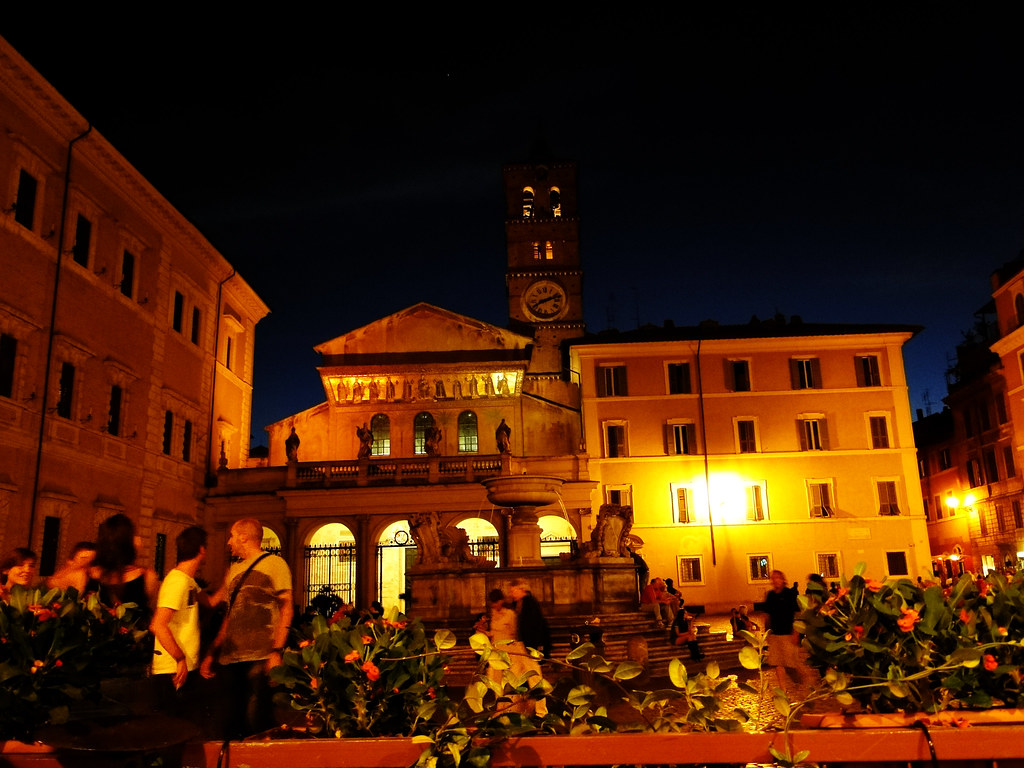
Don’t rush away. The piazza in front of the basilica, with its 17th-century fountain — reputed to be the oldest in Rome — is one of the most alive spaces in the city. In the evening, students sit on the steps of the fountain, musicians play, and the golden mosaic of the façade catches the light of the setting sun. If you have to pick one moment in Rome to sit still and do nothing, pick this one.
Practical information
- Where: Piazza di Santa Maria in Trastevere, a five-minute walk from The Rabbit Hole.
- Entry: Free.
- Opening hours: Every day, morning and afternoon (short closure around lunch).
- Best time to visit: Late afternoon, when the apse mosaic catches the last of the daylight and the piazza begins to fill.
- Combine with: Santa Cecilia in Trastevere (fifteen minutes on foot) for the full Cavallini pilgrimage.
Rome has grander basilicas — St. Peter’s, Santa Maria Maggiore — but none feels quite so warmly at home in its own neighbourhood. Sit in the piazza with an italian coffee and watch a thousand years of daily life continue undisturbed. 🌿🕊️✨
#TheRabbitHoleRome #DiscoverRome #Trastevere #Cavallini #HiddenGems