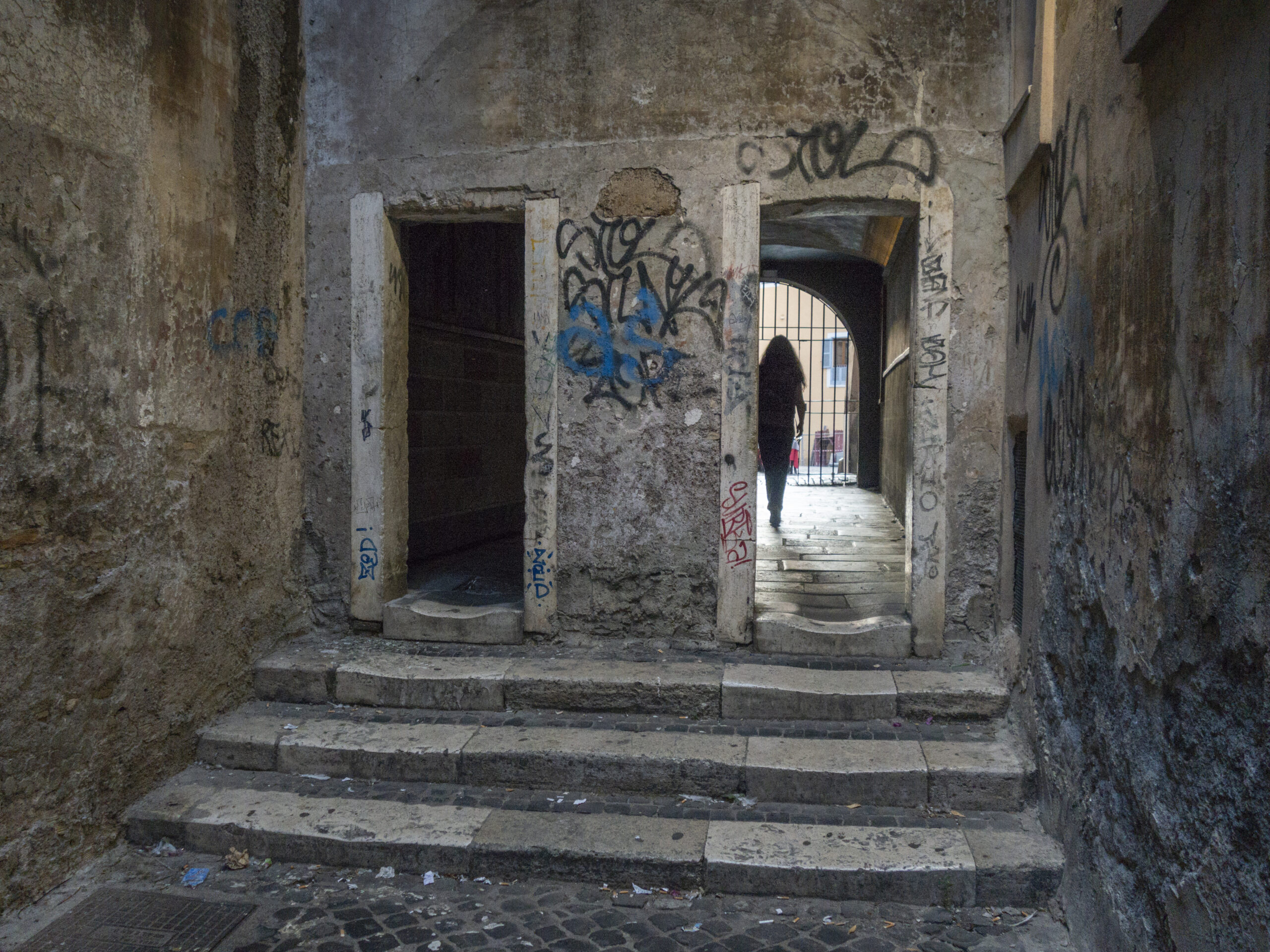
The Passetto del Biscione
A dim, frescoed tunnel two minutes from Campo de’ Fiori — a surviving corridor of the Theatre of Pompey, a Marian shrine, and the source of a Roman proverb still in use today.
Almost no one looks up when passing between Campo de’ Fiori and Piazza Navona. Slip through an unmarked arch under Palazzo Pio Righetti and you find yourself in a narrow covered passage with putti and painted garlands overhead, a sacred image in a glass niche, and the odd sensation of standing inside a two-thousand-year-old building without having been told you were about to enter one. This is the Passetto del Biscione, and it is a piece of the corridor system of the largest theatre of ancient Rome.
From The Rabbit Hole it is about fifteen minutes on foot: over Ponte Sisto, up Via del Pellegrino, across Campo de’ Fiori, and immediately behind the market square into Piazza del Biscione. The entrance is easy to miss twice before you find it.
A corridor of the Theatre of Pompey
Between 61 and 55 BC, Pompey the Great built Rome’s first permanent masonry theatre in what is now the Rione Parione — a vast complex of seating tiers, colonnades, gardens and a temple to Venus Victrix crowning the top row. The Senate met in an annex of it. Julius Caesar was assassinated in that annex on the Ides of March 44 BC, at what is now Largo di Torre Argentina, five minutes away.
The theatre itself vanished, quarried for stone and buried under a millennium of medieval building. But its shape survives in the street plan: the curve of Via di Grotta Pinta, right beside the Passetto, still traces the arc of the ancient cavea. The Passetto was one of the corridors that funnelled spectators from the outside up into the seats. It is not a reconstruction and it is not a fragment displayed in a museum. It is the actual passage, still doing more or less its original job.
In the Renaissance the Orsini family built their palazzo on the theatre’s ruins, incorporating whatever they could reuse. The name Biscione comes from the eel on their coat of arms. The palace later passed to the Pio and then to the Righetti banking family — hence its current name, Palazzo Orsini Pio Righetti — and the arched passage kept the Orsini nickname.
What to see
The vault and the frescoes. The ceiling and walls are painted with putti, slender columns and swags of foliage — sixteenth-century decoration long lost under grime and rediscovered by the restoration completed in 2016. Look up before you look at anything else.
The sacred image. Set into a niche behind glass is a Madonna and Child. This is not the original painting — the story is more layered than the guides make it. The first image placed here, in 1594, was Scipione Pulzone’s Madonna della Divina Provvidenza, moved from the neighbouring church of Santa Maria di Grottapinta; that panel now hangs in San Carlo ai Catinari, and what you see today is a copy in dialogue with a modern Madonna painted for the reopening by Raffaella Curti.
The miracle of 1796. On 9 July of that year, as French troops advanced on the Papal States, a Madonna del Latte venerated in this niche was said to open and close her eyes and follow the crowd with her pupils. She was one of several Roman madonnas that reportedly moved during those weeks of collective dread. The event was so significant that the passage was walled up and reshaped as a chapel a week later, on 15 July, with only narrow openings left at each end — which is how it acquired the shape it still has.
The traces of ancient masonry. Where the plaster and frescoes give way you can read the wall itself: the roughly worked stone of a Republican-era Roman theatre, at eye level, with no glass between you and it.
The insider bit
The Passetto is the direct source of one of the most-used sayings in Roman dialect: “cercà Maria pe’ Roma” — literally, “to look for Mary around Rome”. It means to search for something impossible to find. The image was so well hidden in this obscure passage that pilgrims genuinely got lost trying to locate it, and the expression stuck. Every Roman still uses it. Almost none of them know it started here.
And a proper detour, three minutes away in the Sala Rotonda of the Vatican Museums, is a colossal gilded bronze Hercules almost four metres tall. It was dug up on 8 August 1864 in the courtyard of Palazzo Pio Righetti — directly above the theatre, a few metres from the passage you have just walked through — deliberately buried in a bidental, the ritual pit Romans used for objects struck by lightning. It probably stood in the Temple of Venus Victrix at the top of Pompey’s cavea. It is one of the very few large bronzes of antiquity to have survived because someone treated it as sacred rubble.
Practical information
- Free, no booking, always open — it is a public alley.
- Two entrances: Piazza del Biscione and Via di Grotta Pinta. Slip in from one and out of the other.
- Bring your eyes: the light is low and the frescoes are subtle. Give them a minute to resolve.
- Take a moment for the niche. Whatever you think about the miracle story, this was a hinge point for the people who lived here in 1796.
- Getting there from The Rabbit Hole: fifteen minutes on foot across Ponte Sisto and through Campo de’ Fiori. By bus, the 64 stops on Corso Vittorio Emanuele II at Sant’Andrea della Valle, three minutes’ walk away.
Combine with: the Passetto sits inside one of the densest historical layers in the city. Campo de’ Fiori is thirty seconds away, with its morning market and Giordano Bruno’s statue where he was burned in 1600. Largo di Torre Argentina — the Republican temples and the spot of Caesar’s assassination — is five minutes further, and completes the Theatre of Pompey story. Piazza Navona is ten minutes north for Bernini’s Four Rivers and the great painters in Rome’s churches at San Luigi dei Francesi and Sant’Agostino. All of it slots into the central day of Rome in Three Days from The Rabbit Hole.
Some places in Rome shout. This one whispers, in a corridor Pompey’s audiences walked to their seats, under frescoes some Orsini commissioned, in front of a niche that terrified the city for a week in the summer before Napoleon arrived. Stand still for a minute, then walk out into the light of Campo de’ Fiori and try to explain to yourself what you have just seen.
🌿🕊️✨
#TheRabbitHoleRome #DiscoverRome #PassettoDelBiscione #HiddenRome #HiddenGems