Great Painters in Rome’s Churches
Rome hides some of the greatest paintings in Western art exactly where they were meant to be: above an altar, in a side chapel, in the half-light of a church nobody queues to enter.
There is a version of Rome that costs nothing and has no ticket desk. While the queues coil around the Vatican Museums and the Borghese Gallery sells out weeks in advance, a Caravaggio hangs three metres from your face in a parish church off Piazza Navona, and the door is simply open. No booking, no timed entry, no gift shop at the exit.
From The Rabbit Hole two of the finest are almost on the doorstep — San Francesco a Ripa is a five-minute stroll through Trastevere, and San Pietro in Montorio sits fifteen minutes uphill on the Gianicolo, with the best free view in the city thrown in. Everything else on this trail lies across the river, clustered so tightly between Piazza Navona and the Pantheon that you can see four masterpieces in an afternoon and still be back for an aperitivo on this side of the Tiber.
Why Rome’s best gallery has no ticket desk
The reason is competition. In the decades after the Council of Trent, Roman families and religious orders fought each other for visibility in the most trafficked churches in Christendom, and the currency of that fight was art. A chapel was a family’s public face: whoever commissioned the boldest painter won the argument.
That is why the work here is so often the loudest thing an artist ever made. These paintings were not designed for a museum wall at eye level with a label beside them. They were built to work in dim naves, seen from an angle, lit by candles and by whatever daylight the architect allowed in — which is precisely why Caravaggio’s light falls the way it does, and why Baroque ceilings seem to tear the roof open.
It is also why so many of these works stayed put. The paintings that ended up in museums are the ones that were rejected, sold, or looted. What remains in the churches is, in a real sense, the art that worked.
Caravaggio churches in Rome
Three churches hold the essential Caravaggio circuit, and all three are within a ten-minute walk of one another.
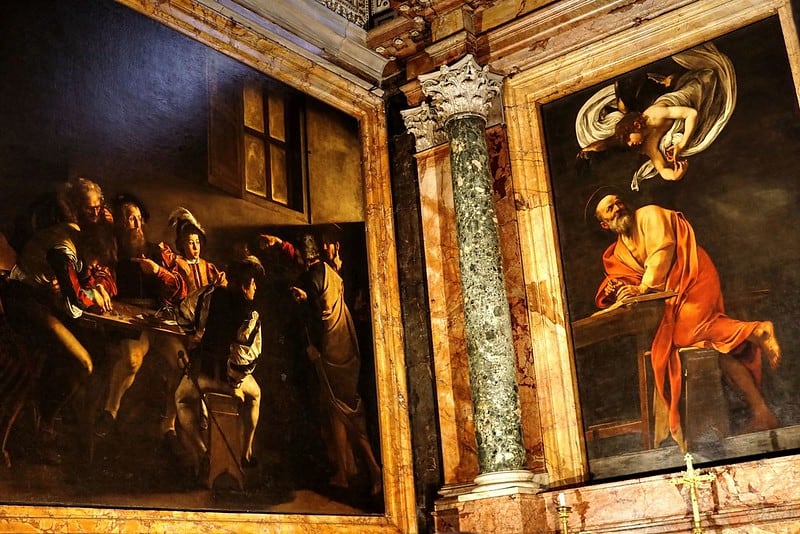
San Luigi dei Francesi, the French national church beside Piazza Navona, holds the Contarelli Chapel and the three canvases on the life of Saint Matthew — the Calling, the Martyrdom, and Saint Matthew and the Angel. The Calling is the one that changed painting: a shaft of light entering a shabby room full of men counting money, and a hand gesture borrowed straight from Michelangelo’s Creation of Adam. Stand to the left of the chapel rather than in front of it, and the light in the painting lines up with the real window above you.
Santa Maria del Popolo, at the north end of the piazza of the same name, keeps the Crucifixion of Saint Peter and the Conversion of Saint Paul in the Cerasi Chapel. Almost everyone photographs the two Caravaggios and walks out — which means almost everyone misses that the altarpiece between them is by Annibale Carracci, and that the whole chapel was conceived as a face-off between two rival visions of what painting should be. In the same church, Pinturicchio frescoed the Della Rovere Chapel and the apse vault, and Raphael designed the Chigi Chapel, later completed by Bernini.
Sant’Agostino, a short walk from San Luigi, has the Madonna of the Pilgrims — the Virgin leaning in a doorway, and two kneeling pilgrims whose dirty bare feet are pushed toward the viewer. Roman churchgoers were scandalised. It is in the first chapel on your left as you enter, not by the high altar, so people frequently walk straight past it.
Renaissance masters, a few streets apart
Sant’Agostino also holds Raphael’s Prophet Isaiah, frescoed on the third pillar of the left nave — not by the entrance, as guides often repeat. Raphael painted it just after seeing the Sistine ceiling, and the debt to Michelangelo is so obvious that contemporaries teased him for it. Directly beneath it stands Andrea Sansovino’s Saint Anne, Virgin and Child, part of the same commission. On the entrance wall of the church, in a separate shrine, is a different Sansovino altogether — Jacopo’s Madonna del Parto, still surrounded by the photographs and ex-votos left by expectant mothers.
At San Pietro in Montorio on the Gianicolo, Sebastiano del Piombo’s Flagellation of Christ occupies the first chapel on the right. It was commissioned by the Florentine banker Pierfrancesco Borgherini — the Della Rovere attribution you will find in some guides belongs elsewhere in the church’s history — and Michelangelo supplied drawings for the figures, which is why the bodies feel sculpted rather than painted. Step into the courtyard afterwards for Bramante’s Tempietto, one of the most quietly perfect buildings in Europe.
At Santa Maria sopra Minerva, behind the Pantheon, Filippino Lippi frescoed the Carafa Chapel with the Triumph of Saint Thomas Aquinas and a startling Annunciation. This is late Quattrocento work, not High Renaissance, and its restless invention is exactly what makes it worth the detour. Michelangelo’s Christ the Redeemer stands beside the high altar in the same church.
Baroque: ceilings that open and marble that breathes
Chiesa del Gesù, near Piazza Venezia, has Giovanni Battista Gaulli’s Triumph of the Name of Jesus — a nave ceiling where painted figures spill out of the frame and cast painted shadows onto real stucco. There is usually a mirror on the floor so you can look at it without wrecking your neck.
Santa Maria in Vallicella, the Chiesa Nuova near Campo de’ Fiori, holds Rubens’ high altar complex, painted during his Roman years and still in the setting he designed it for. The centre is his Madonna della Vallicella, and behind it hides an older miraculous fresco of the Virgin: Rubens painted a second Madonna on a copper panel to cover the icon, and a pulley system lifts the copper away on major feast days. Pietro da Cortona covered the nave, dome and apse decades later.
And though this is a trail of painters, two Bernini sculptures belong on it because they were conceived as paintings in stone. The Ecstasy of Saint Teresa in Santa Maria della Vittoria, near Piazza della Repubblica, is staged like a theatre box with the Cornaro family watching from the sides. The Blessed Ludovica Albertoni in San Francesco a Ripa — the closest of all these works to The Rabbit Hole — is late Bernini, lit through a hidden window, and far more moving than the famous one.
The insider bit
Several of these chapels stay dark until someone pays for the light. Bring a small handful of coins for the illumination boxes, and if a tour group has just fed the machine, walk in behind them and enjoy the free minutes. Better still, go while the groups are eating: between one and three in the afternoon, Santa Maria del Popolo and Sant’Agostino are often close to empty, and you can have a Caravaggio entirely to yourself.
One correction worth carrying with you: Santa Maria Maggiore is often listed for a Guercino of Saint Luke painting the Virgin, but that canvas is in an American museum. What the basilica actually holds is the Salus Populi Romani, the icon that tradition itself attributes to Luke as the first painter of the Virgin — and, far more importantly, fifth-century mosaics that predate every painter on this page by a thousand years.
Practical information
- Entry is free in all of these churches; a donation or a coin in the light box is the decent minimum.
- Opening is generous but not continuous — most run from morning to late afternoon, with a long midday closure. Always worth a check on arrival.
- Dress code applies: shoulders and knees covered, or you will be turned away at the door.
- Services take priority. If Mass is being said, the chapels are not for visiting. Wait it out or come back.
- No flash, no tripods, and in a few chapels no photography at all.
- Walkable in two halves: the Navona–Pantheon–Popolo cluster in one outing, and the Trastevere–Gianicolo pair as a short local loop from the apartment.
Combine with: pair San Francesco a Ripa with Castel Sant’Angelo for the full arc of Bernini’s career, or extend the Trastevere half with Santa Cecilia in Trastevere and Santa Maria in Trastevere for Cavallini’s mosaics and frescoes. For layered Rome underground, the Basilica of San Clemente is the natural next step. All of it fits inside Rome in Three Days from The Rabbit Hole.
There is a particular silence that falls when you push open a heavy leather curtain, drop a coin in a box, and watch a four-hundred-year-old painting come out of the dark for exactly the time you paid for. No museum can sell you that. In Rome it is simply there, on a side street, waiting for whoever bothers to walk in.
🌿🕊️✨
#TheRabbitHoleRome #DiscoverRome #Caravaggio #RomanChurches #HiddenGems