Why Is Rome Called Rome?
Nobody knows for sure. The Romans didn’t either — and the guesses they made are more interesting than any single answer.
We say “Rome” so often we forget it is a strange, short, ancient word. The Romans themselves argued about where it came from. Servius, a grammarian writing in the fourth century AD, admitted the etymology was already lost; Plutarch, three centuries earlier, listed a dozen contradictory versions and refused to pick one. What survives is a set of parallel stories — one geographical, one geological, one mythical, one linguistic — each of them true to a different piece of the city.
Understanding those pieces changes how you walk through Rome, because the places where the answers are hiding are still here, and from The Rabbit Hole most of them are within thirty minutes on foot. The Palatine, the Tiber Island, the Aventine and the Forum sit in a tight cluster on the other side of the river.
Where the name might come from
From the river. The oldest surviving explanation, cited by Servius, derives Roma from Rumon, an archaic name for the Tiber. The root is the Latin ruo and the Greek rhéō, “to flow” — the same root as ruminate, to turn something over. In this reading, Rome is simply “the city on the flowing river”. Everything about how the settlement grew supports it: Rome exists because the Tiber does.
From the shape of the land. The Etruscan word ruma meant a rounded swelling — a breast, and by extension any breast-shaped hill or bend in a river. Some scholars refer the term to the curve of the Palatine and Aventine above the water; the philologist Massimo Pittau argued it originally described the low bulge on the right bank of the Tiber, opposite the Tiber Island, which was Etruscan territory. Either way, the same root gave its name to the ficus ruminalis, the wild fig at the foot of the Palatine under which, according to legend, the she-wolf suckled Romulus and Remus.
From Greek. Pelasgian settlers, Plutarch reports, called the place rhōmē (ῥώμη), strength. Whether or not Pelasgians were ever really here, the association stuck: for centuries, Greeks who wrote about Rome heard the name of their own word for power.
Then the odd ones. A Trojan girl named Roma who burned her people’s ships at the mouth of the Tiber so they would settle here. A daughter of Telemachus who married Aeneas. And a favourite of the late Byzantine writer John the Lydian in the sixth century: read Roma backwards and you get Amor — love. The palindrome was treated for a while as one of the city’s secret names, whispered rather than spoken.
None of these can be proven and no scholar today would defend any of them alone. But listed together, they map the city precisely: river, hill, strength, myth, and the small pleasure of a word that reverses into another.
How the city actually began
The traditional date is 21 April 753 BC, calculated back from Republican records by the antiquarian Marcus Terentius Varro in the first century BC. It is astonishing that Rome still marks the day — the Natale di Roma is celebrated every April in the Circus Maximus — but Varro’s date is a scholar’s reconstruction, not a birthday.
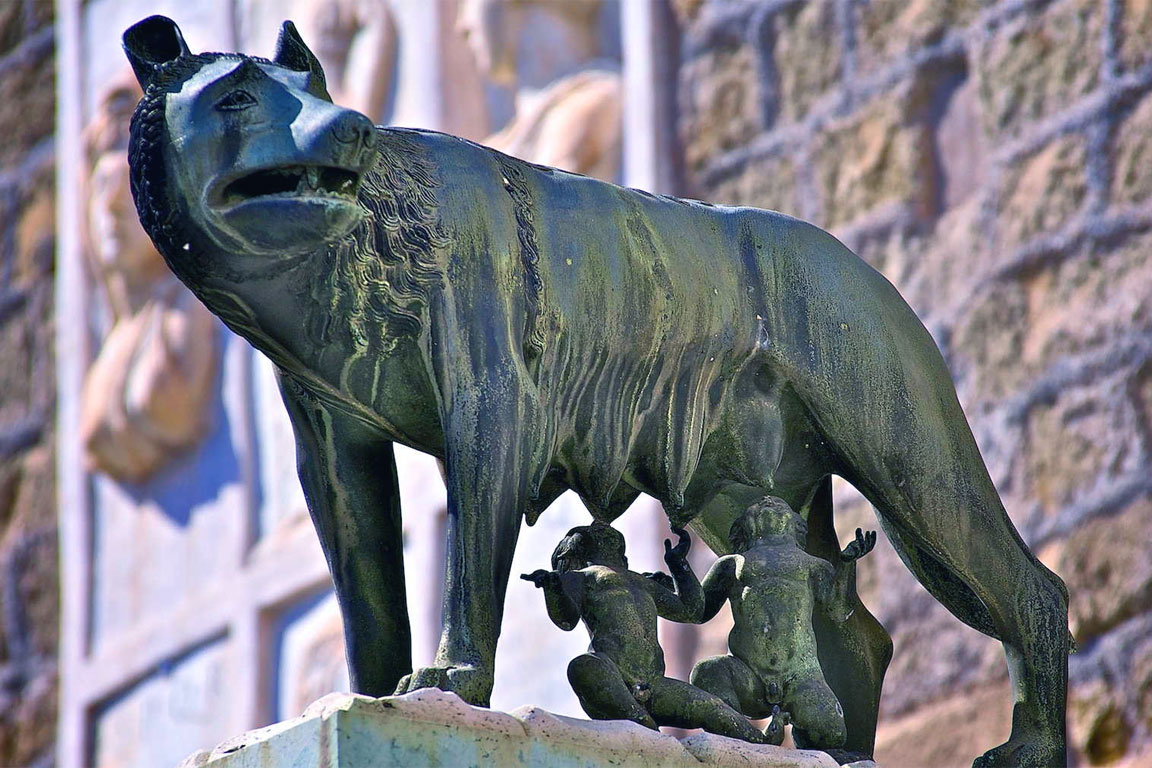
The legend the date belongs to is the one everybody knows. Twin sons of Rhea Silvia, set adrift on the Tiber, washed ashore at the foot of the Palatine and suckled by a she-wolf in a cave called the Lupercal. Raised by the shepherd Faustulus, Romulus later traced a sacred furrow around the hill, killed Remus for jumping it, and gave his name to the city he had marked in the earth.
Archaeology tells the same story in slower motion. On the Germalus, one of the three summits of the Palatine, the post-holes of three Iron Age huts survive, cut directly into the tufa in the eighth century BC — exactly the period Varro’s date belongs to, and precisely where ancient tradition placed the Casa Romuli, Romulus’s hut. The Palatine settlement did not spring up alone: villages on the Capitoline, the Aventine and the Quirinal were already there, controlling the ford of the Tiber at the Tiber Island. Sometime in the eighth or seventh century BC, driven by trade and defence, they merged into a single community whose common meeting ground drained and became the Roman Forum.
The founding of Rome was, in short, both a myth and a merger. It happened because a group of hilltop farmers realised the ford beneath them was the only good crossing for miles, and the hills above it were defensible. Everything else — republic, empire, basilica, dome — grew from that one commercial and topographic fact.
Where you can still feel the beginning
The Palatine. Not the imperial palaces on top, though those are extraordinary. Go to the south-western corner, near the Temple of the Magna Mater, where the huts of the Germalus survive as holes in the rock. Stand there and you are, quite literally, on the ground of the first Rome.
The Tiber Island. The reason for everything. Walk across the Ponte Fabricio (built in 62 BC and still bearing its original inscription, the oldest bridge in Rome still in use) and think about the fact that this is why the city is here.
The Aventine. The hill the losing twin chose. Remus took his auguries from here and saw six vultures first; Romulus, watching from the Palatine, then saw twelve. The quarrel was whether priority or quantity mattered — the twins fought, Remus died, and Rome ended up on the wrong hill from Remus’s point of view. From the Orange Garden the whole basin of the early city is laid out beneath you.
The Roman Forum. The marshy valley between the first hilltop villages, drained by the Etruscan kings so their descendants would have somewhere to meet. It became the common ground on which the merged community argued itself into an empire.
The insider bit
The Lupercal — the cave where the she-wolf story unfolds — may not be entirely legendary. In 2007 a probe lowered through a fissure on the Palatine’s south-western slope, under the House of Augustus, revealed a decorated cavern that some archaeologists, led by Andrea Carandini, identified as the sanctuary Augustus restored precisely because it was the site of the myth. Other specialists — including the former superintendent Adriano La Regina — argue the real Lupercal must lie further west, in front of the temples of Magna Mater and Victory, and that the ipogeo is more likely a private nymphaeum. The debate is unresolved, and the cavity is closed to the public in any case. But you can walk on the ground above it: the House of Augustus terrace, near the Temple of the Magna Mater, sits directly over a hole whose identity Rome is still arguing about. Knowing it is there changes what you are standing on.
And one small piece of trivia to carry with you: Rome’s oldest secret name, according to late antique authors, was Amor — the city’s palindrome, spoken only by priests during certain rites, because to know a city’s true name was to hold power over it. Whether or not any Roman ever kept the secret, the play on the two words has kept its charge for two thousand years. Every Latin lover in every bad novel since is trading on it.
Practical information
- All four sites are free or cheap: the Aventine and Tiber Island cost nothing; the Palatine and Forum share a single small ticket, and the Colosseo card covers both.
- The right order is the historical one: Tiber Island first (why Rome is here), Palatine second (where it began), Forum third (what it became), Aventine last for the view.
- Give it half a day. Two hours is too little; a whole day is too much unless you’re an archaeologist.
- Bring water and a hat on the Palatine — there is very little shade among the ruins.
- Getting there from The Rabbit Hole: ten minutes on foot to the Tiber Island via Ponte Cestio; twenty minutes to the Palatine entrance via Ponte Palatino; fifteen minutes to the Aventine and the Orange Garden via Ponte Sublicio.
Combine with: the whole story fits inside a single day. Read the Orange Garden for the Aventine leg, and cross into the historic centre with the Passetto del Biscione for a piece of ancient Rome still built into the modern city. Both threads meet in Rome in Three Days from The Rabbit Hole, which walks the founding cluster on day two.
Rome refuses to give a single answer to its own name, and after a while you stop wanting one. The city is the river and the hill and the strength and the girl who burned the ships and the word read backwards — all of it at once, still here, still readable in the ground under your feet.
🌿🕊️✨
#TheRabbitHoleRome #DiscoverRome #AncientRome #Palatine #HiddenGems