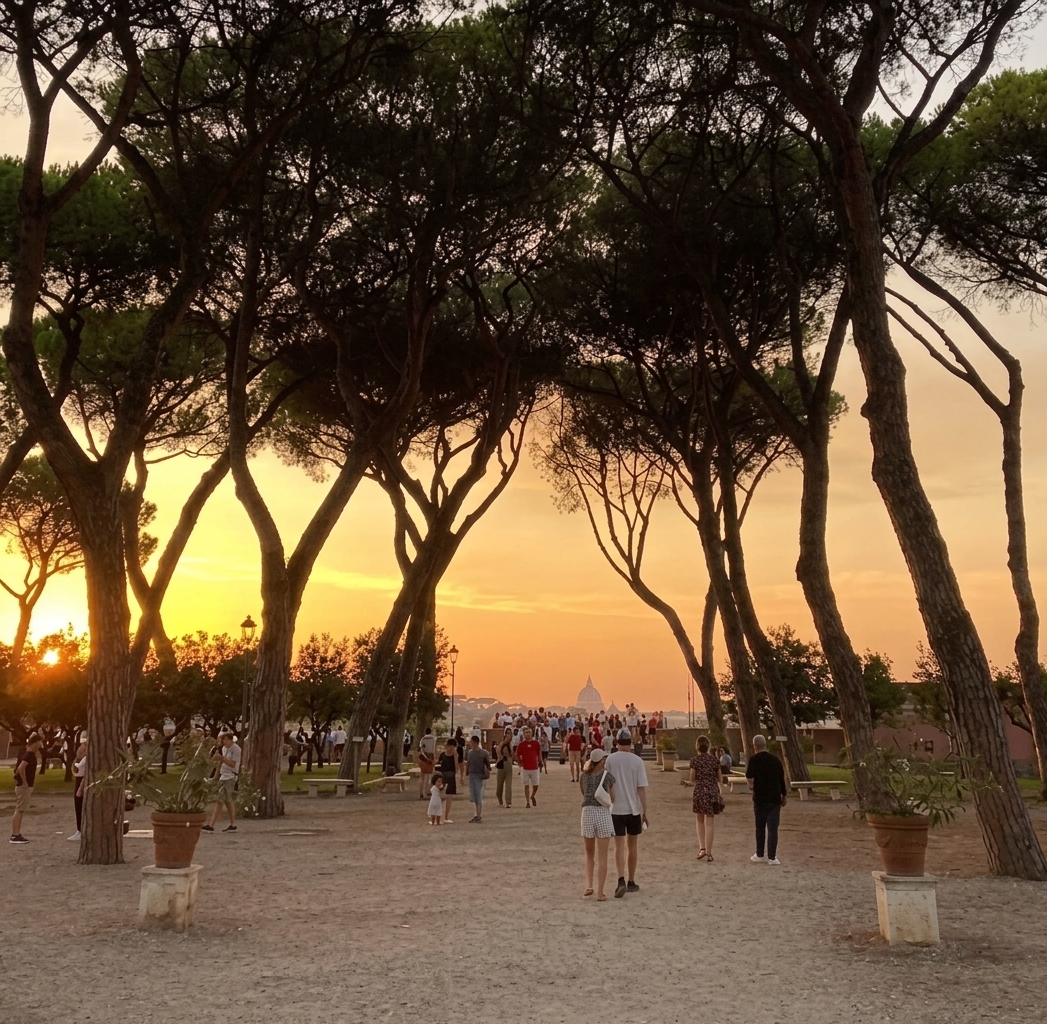
The Orange Garden
(Giardino degli Aranci)
A walled terrace of bitter orange trees on the Aventine, with the whole of Rome laid out below it — and not a ticket booth in sight.
Every guide sends you to the Pincio or the Gianicolo for the view. The Aventine keeps a third one, smaller and far more intimate, hidden behind a stretch of medieval wall on a hill most visitors never bother to climb. Push open the gate on Piazza Pietro d’Illiria and you find a formal grove of orange trees, a gravel avenue running dead straight toward a stone parapet, and beyond it the Tiber, the rooftops of the centro storico and the dome of St Peter’s floating above everything.
It is a twenty-minute walk from The Rabbit Hole — about a kilometre and a half, most of it flat, with a short climb at the end — and the route happens to pass three of the best-known monuments in Rome. Which makes this less a destination than the reward at the end of a very good stroll.
A fortress, a monastery, a vegetable garden
The garden’s proper name is Parco Savello, and the wall that encloses it is the reason. Between 1285 and 1287 the Savelli family built a fortress here beside the basilica of Santa Sabina, raising it over an older castle the Crescenzi had put up in the tenth century. What you walk through today is the courtyard of that stronghold, minus the stronghold.
When the property passed to the Dominicans of Santa Sabina, the soldiers’ ground became a monastery and the enclosure became a vegetable garden — which is how the oranges arrived. Tradition credits Saint Dominic with planting the first tree, carried as a sapling from Spain, and adds that Saint Catherine of Siena picked its fruit, candied it, and sent it to Pope Urban VI. It is a legend, but a durable one: the Dominicans have been tending citrus on this hill for seven centuries.
The park as you see it is much younger. In 1932 the architect Raffaele De Vico redesigned the space to open the hillside view to the public, deliberately adding a third belvedere to the Pincio and the Gianicolo. Roughly 7,800 square metres, laid out with a symmetry that feels almost cloistered — which, given the history, is exactly right.
What to see
The terrace. The obvious reason to come. The parapet frames the Tiber bend, Trastevere, the Synagogue dome and St Peter’s in a single sweep. Late afternoon is the classic hour, but the light is arguably better an hour after sunrise, when you may well have the whole railing to yourself.
The avenue and the square. The central path is named for the actor Nino Manfredi, the square for Fiorenzo Fiorentini, who ran the park’s summer theatre season for years. Roman actors rather than popes or generals — a small, telling piece of local memory.
The fountain at the gate. The one in Piazza Pietro d’Illiria is a collage of two unrelated objects: a Roman bath basin, and a monumental marble mask carved by Giacomo della Porta in 1593 for a fountain in the old cattle market at the Forum. That fountain was dismantled in 1816, the mask reused on the Tiber’s right bank from 1827, demolished again in 1890, then left in a municipal warehouse until someone finally brought it up here. Roman recycling at its most characteristic.
The Savelli walls. Sections of the medieval fortress survive around the perimeter. Walk the edges rather than just the middle and you can read the castle in the masonry.
Santa Sabina, next door. A fifth-century basilica with columns lifted from a pagan temple, windows of thin translucent selenite instead of glass, and cypress-wood doors carved with what is probably the earliest surviving Crucifixion scene in Christian art. Free, empty, and two minutes from the garden gate.
The insider bit
The oranges are ornamental bitter oranges. People try one every day and regret it every day — leave them on the tree.
And the real prize is not in the garden at all. Saint Dominic’s original orange tree — or what tradition claims of it — is not among the trees you walk past: it grows in the cloister of Santa Sabina and is visible through a small window in the convent corridor. Ask politely at the basilica.
Then walk two minutes to Piazza dei Cavalieri di Malta and look through the keyhole of the green door. The Priory garden’s hedges frame St Peter’s dome perfectly, three kilometres away. There is often a short queue and it is worth every minute of it.
Practical information
- Free entry, no booking, gates open from morning until dusk — hours shift with the season, so worth a check on arrival.
- Sunset is crowded. Early morning is the same view with nobody in it.
- Shade and benches make this a good midday stop in high summer; there is no bar inside, so bring water.
- Getting there on foot from The Rabbit Hole: head east along Viale Trastevere to Ponte Sublicio, cross the river, then turn left toward Santa Maria in Cosmedin. From Piazza della Bocca della Verità take Via della Greca, follow it to the Circus Maximus, then climb Via di Valle Murcia and the Clivo dei Publicii to Piazza Pietro d’Illiria. Twenty minutes at an unhurried pace.
Combine with: the walk itself is the itinerary. Stop at the Bocca della Verità and the two temples of the Forum Boarium on the way up — the round one is the Temple of Hercules Victor, not Vesta, whatever the postcards say — then take in the Circus Maximus before the climb. On the way down, Trastevere is ten minutes away for Santa Cecilia and Santa Maria in Trastevere. The whole stretch is folded into Rome in Three Days from The Rabbit Hole.
Gardens like this are why staying in Rome beats visiting it. You can walk up on an ordinary evening, with no plan and no ticket, stand under the orange trees while the city turns amber below you, and be home in time for dinner.
🌿🕊️✨
#TheRabbitHoleRome #DiscoverRome #OrangeGarden #Aventine #HiddenGems